
Moving resources
Cardboard vs. plastic moving boxes: which is better for your move?
Both work. People have been moving with cardboard for a hundred years and it still does the job. The question worth asking is which one fits your move, and that has less to do with the material than with how far you’re going and how much time you have.
The short version
If you only read one paragraph
Rent totes if your move is local. They arrive assembled and sanitized, they stack without collapsing, the lids clip on so you never buy tape, and somebody else hauls them away when you’re done. Buy cardboard if you’re leaving the area, putting things into storage, or packing something awkward like a TV. On money the two land closer than most people expect, so it usually comes down to what your time is worth.
Side by side
The comparison, in one place
Six differences you’ll notice once you start packing.
- Up-front cost
- CardboardAround $160 to $255 all in. Free if you can scrounge them.
- Rented totesOne flat fee you know before you book, delivery included.
- Getting them
- CardboardYou find them, haul them home, and build every one.
- Rented totesDropped off clean, assembled, and ready to fill.
- Under a stack
- CardboardCorners soften, sizes vary, tall stacks lean.
- Rented totesRigid, uniform, lids clip on. Stacks stay square.
- In the rain
- CardboardGoes soft fast once it's wet.
- Rented totesDoesn't care.
- Afterward
- CardboardBreaking down and hauling off the pile is on you.
- Rented totesWe come get them. Nothing on your curb.
- Best at
- CardboardLong moves, long storage, awkward items.
- Rented totesLocal moves, tight timelines, anything you want off your plate.
Cost
What each one really costs
Cardboard
A two or three-bedroom house takes somewhere around 50 boxes in mixed sizes. That’s $125 to $150 at Home Depot or Lowe’s prices, before tape, markers, and the wardrobe and dish boxes most people end up wanting. The big-box stores sell pre-built kits for two to four-bedroom homes at $159 to $254, which tells you roughly where you land.
Free boxes beat that, if you have somewhere to get them. They cost nothing but the evenings you spend collecting them, and rounding up fifty matched, intact boxes is harder than it sounds.
Then there’s the back end. Breaking down fifty boxes and driving them to a recycling center lands in the week you have the least energy for it, which is why so much of it ends up in the trash. If that week is now, here is where each box goes.
Rented totes
Rental is one flat number you know before you book. At ReadyCrate, our Standard package is $229 for 14 days and includes 50 totes and 1 dolly, which is the size most two and three-bedroom moves land on. Delivery and pickup together are $29 in Zone A, one fee covering both trips rather than one each.
- Standard package
- $229
- Delivery and pickup (Zone A)
- $29
- A typical local move
- $258
That covers the dollies, the labels, dropping them off, and picking them back up. Nothing to buy, nothing to assemble, nothing left over. Packages start at $149 for 30 totes if you’re moving a studio or a one-bedroom, and our full pricing has the rest along with the delivery zones.
If you’re buying boxes new, the two land close enough that price probably isn’t what should decide it.
Moving day
Where the difference shows up
The gap is small while you’re packing and much bigger on the day you actually move.
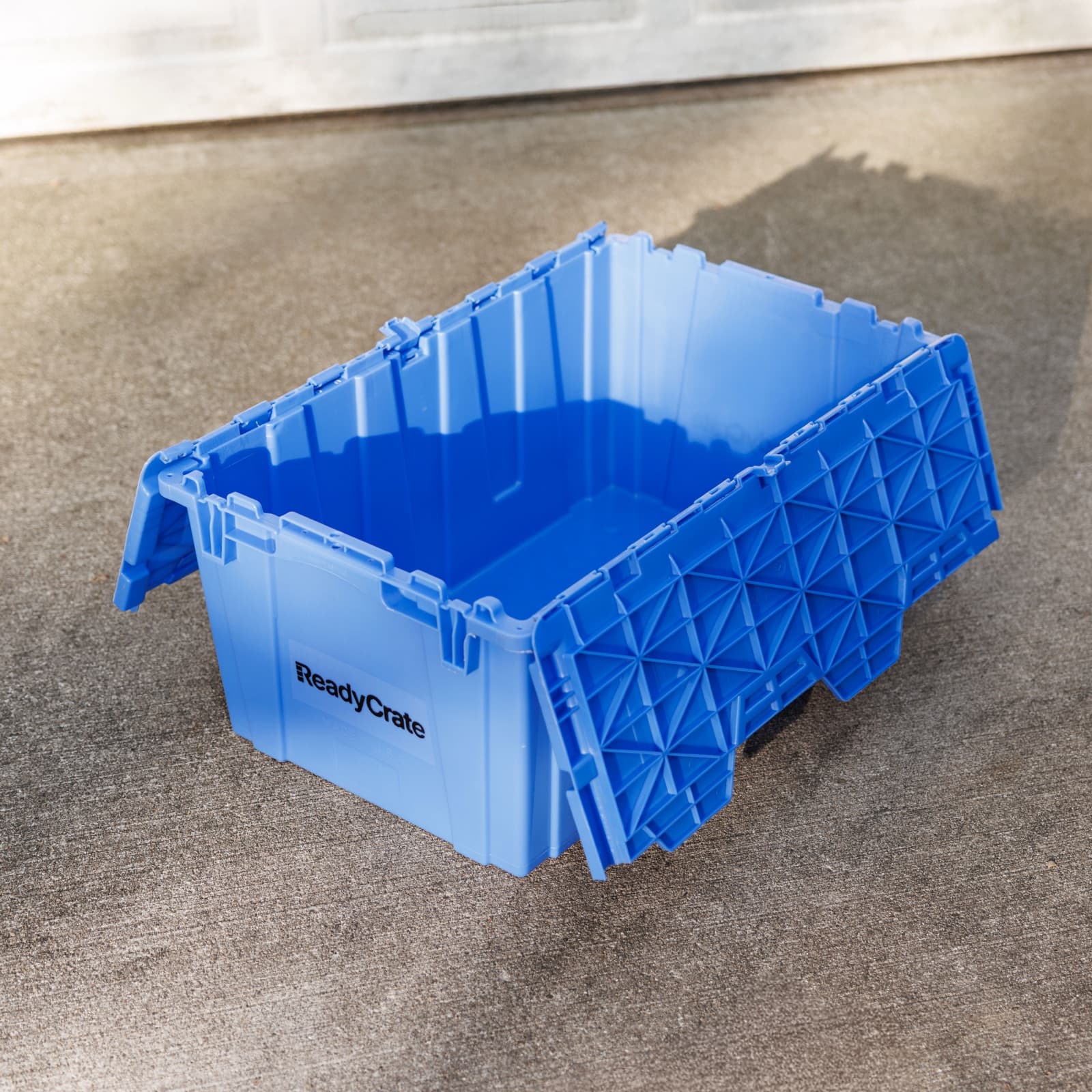
Cardboard shows up flat. Every box gets opened, folded, and taped before anything goes in it. Fifty of those is an evening you don’t get back. Totes show up as totes. Pull a lid off and start filling.
Then there’s stacking. Cardboard comes in whatever sizes you found, and the corners soften under weight, so a tall stack settles and starts to lean. A heavy box sitting on a soft one is how things get crushed. Totes are all one size with lids that clip on. They stack square in a truck, they hold their shape, and nobody has to rebuild the pile at the other end. If you’ve hired movers, they’ll notice.
Weather is the one people forget. Move during a Kansas City spring and there’s a decent chance of rain, and cardboard sitting in a damp garage overnight goes soft. Totes don’t care.
Our how it works page walks through what a rental week looks like, from the delivery window to pickup.
What you get
What a tote does that a box can’t
Start with the handles. That sounds like nothing until you’ve carried forty cardboard boxes by pinching the bottom corners, switching hands halfway across the yard because there’s nowhere good to hold on. A tote has handles where your hands already are.
They arrive clean and numbered. We wash and sanitize every tote between rentals, and the numbers mean you can find the box with the coffee maker in it without opening six lids.
The lids clip on, so there’s no tape. Nothing to buy, nothing to cut through on the other end, and no penalty for opening a tote, taking what you need, and closing it again. Cardboard makes you pay for changing your mind.
One dolly come with the Standard package, and rolling a loaded stack out to the truck beats carrying boxes one at a time. They show up before you start packing and leave after you’ve unpacked, so the boxes are never the thing holding up your move.
Straight answer
When cardboard is the better choice
We rent totes for a living and we still tell people this. Some moves are just better off with cardboard.
You’re moving out of the area
Rented totes have to go back to whoever owns them, so they only work inside a local service area. If you’re leaving the metro, buy boxes.
Things are going into storage for months
Rentals are priced by the week, so a long storage stretch stops adding up fast. If your things will sit in a unit through a closing delay or a renovation, buy cardboard.
You have oddly shaped or fragile things
Totes are all one size, which is why they stack so well and also why a TV or a full-length mirror won’t go in one. Rent totes for the bulk of the move and buy a few specialty boxes for the awkward pieces.
You don’t know your dates yet
Rentals run on scheduled windows. If you couldn’t say within a couple of weeks when you’re moving, boxes that sit in a corner until the date firms up are less stressful.
Waste
The environmental part, honestly
Totes get sold as the green option. That’s true, but not for the reason people usually give. A plastic tote takes more to make than a cardboard box does. One tote used one time would be the worse choice by a wide margin.
It’s the reuse that changes the math. A rental tote doesn’t get used once. It gets cleaned and sent back out dozens of times over its life, and it replaces a stack of boxes on every one of those moves. That’s the whole argument, and it falls apart if the totes stop circulating.
When one finally cracks, that isn’t the end of it either. The totes are polyethylene, the same family of plastic as a milk jug, and a retired tote goes to a plastics recycler instead of a landfill. They’re far too big for a curbside bin, so that part is on us rather than on you.
Cardboard’s defense is that it’s recyclable, which is true. The catch is what happens to moving boxes in practice. They get taped up, they get wet in the garage, and a lot of them go in a dumpster during the week nobody has the patience to break down fifty boxes and drive them anywhere. Recyclable and recycled aren’t the same thing.
Bottom line
How to decide in about a minute
Three questions. Is the move local? Can you get cardboard for free? And what’s a Saturday worth to you right now?
If you’re leaving the area, or the boxes are headed for storage, cardboard is your answer, and we’d rather say so than sell you something that doesn’t fit. If the move is local and you can get boxes free and you have the evenings to build them and haul them off, cardboard still makes sense.
If the move is local, you were going to buy boxes anyway, and the weeks around it are already full, that’s what totes are for. About the same money, a few hours back, and nothing on your curb at the end.
Questions
Common questions
Not always, and the gap is smaller than people think. Fifty new boxes for a two or three-bedroom move run about $125 to $150, and the big-box stores price their own pre-built two to four-bedroom kits at $159 to $254. Renting totes for the same move lands in the same neighborhood, and that price includes delivery, pickup, dollies, and labels. If you can get cardboard free, cardboard wins on cash. If you're buying new, it's close to a wash, and then it comes down to what your time is worth.
Close, but not one for one. A tote holds 2.5 cubic feet, which puts it between a small cardboard box and a medium. Totes are all one size and you fill every inch of them, so the total usually lands a little under a mixed set of boxes. Most two and three-bedroom homes come in around 50 totes. Kitchens and books run the count up faster than furniture does. People almost always guess low, so if you're torn between two sizes, take the bigger one.
Yes, and it's the difference you notice most on moving day. Totes are all one size with lids that clip on, so they stack square and hold their shape in a truck. Cardboard comes in mixed sizes, softens at the corners under weight, and settles as the load shifts. A tote stack also survives being loaded, driven, and unloaded without anyone rebuilding it.
Usually not, and this is where cardboard is the better call. Rented totes have to go back to the company that owns them, which only works inside a local service area. If you're moving out of the metro, buy cardboard or buy your own totes outright. ReadyCrate rents in Johnson County and the surrounding Kansas City metro. Past that, cardboard is the honest answer.
Only because of reuse. A single plastic tote takes more to make than a single cardboard box, so one tote used one time would be the worse option. What flips it is that rental totes don't get used once. The same tote serves dozens of moves before it's retired, and it replaces a stack of boxes each time. Cardboard is recyclable, which helps, but moving boxes often end up taped, wet, or in the trash instead. Our totes are polyethylene, and a worn-out one goes to a plastics recycler rather than a landfill.
Most movers are glad to see them. Totes have handles, which sounds small until you watch someone carry forty cardboard boxes by pinching the bottom corners. They also stack uniformly, they don't collapse mid-load, and the crew isn't working around forty different box sizes. It's worth telling your moving company you're using rented totes when you book, mostly so they know the containers are going back to someone and shouldn't be broken down or taken.
More on rentals, damage, and delivery windows on our FAQ page. Still working out how many you need? Our room-by-room box count runs the numbers for every home size. We deliver across Johnson County and the Kansas City metro, including Overland Park, Leawood, and Olathe.
Skip the box run entirely
Pick a package, enter your ZIP, and we'll have totes at your door before you start packing.